







Highlights
New Releases
The Wondrous and Paradoxical Ethos of Monasticism
To become an image of Pentecost, the monk must be a worker of repentance, a man of ardent desire, and persevere in the earthquake of repentance that renews his soul. Then he will bear witness to the humble ethos of Christ which has overcome his nature. This ethos reveals the supernatural transformation he has undergone: from a divided and distorted being into a living image of the Lord Jesus.
$31.00
The Ineffable Folly of Divine Love
The angels are always mindful of their createdness: they cover their faces and their feet with four wings to preserve their humility before the Lord Who brought them from non-being into being. Although they are immortal and incorporeal beings, they never forget that they are creatures, that they are not without beginning. Therefore, it is with restrained boldness – with only two wings – that they fly around ‘the throne of the Majesty in the heavens’. Humility gives them the strength to abide in everlasting doxology before God.
$32.00
Audiobook: Remember Thy First Love
Audiobook Sample
Total listening time: 17 hours, 3 minutes
$22.00
Latest Reviews
What the Readers Say
This was used to gift my wife a book from the bookshop. It is possibly the most beautiful and lovingly wrapped gift I’ve ever seen. The contents inside are truly precious and are treated as such with the articulately prepared packaging. Flowers from the church, a beautiful seal, and a work of art in its own right. Thank you so much for making a special gift even more special.
I gave this book as a Christmas gift to my wife. We both attend the monastery talks online and we both enjoy Father Zacharias’ insights. It is beautifully bound and is something to be treasured. This book will be a great tool in our journey along the way.
The order and book arrived in good condition and in good timing to go way over to Alaska, USA, from Essex. Thank you so much for such edifying words to help us on our life’s way to Christ.
I always get a couple of Orthodox Calendars from different sources. But this one is my favorite. I hope one day to visit the monastery. Meanwhile, I have these beautiful pictures to view! And I also appreciate the details regarding the feast days and the notes area at the bottom of the page. I’m learning Greek and enjoy the words written on the calendar picture pages in both Greek and English.
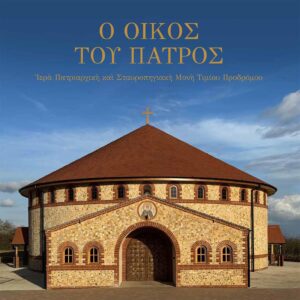
Very beautiful calendar, like the images of Saint Sophrony’s church. Have read the book “The House of Our Father” a few months ago, which I highly recommend for the explanations on how the new church came into being. It’s very nice to look at the calendar and remember the Monastery with love every time I glance at it. Thank you :).
It seems a little strange to comment on a book which I have not yet finished but I have learned such a strong lesson from it that I wanted to describe it – and I know that your prayers are with your readers.
At first the book frightened me. I would read a little, put it down and even wonder if I was wise to resume the next day. But I was carried along… The intensity and depth of the experiences described awoke buried experiences of my own. I compare a grain of sand to a mountain but I also explored other religions and have been granted passing moments of falling into an unspeakable black void.
I had attributed these moments to psychological disturbance and who knows that there could have been an element of this. Now I see their great value in placing before me in the clearest terms the choice of this, or Christ.
“These invisible paths are suspended across an abyss. No other power, no other wisdom – only unshakeable belief in Christ-God can save us from being storm-tossed and hurled into the black depths.” pp. 122-123.
It strikes me with awe that these depths were sustained in the saint for years on end. By his pain, which is Christ’s, I have found healing Light.
Gift a Book
Gift Wrap
🎁 You can gift your order. Please leave us a note at the checkout what to gift wrap.
🎗️ We can wrap it nicely, add a beautiful ribbon and then a wax seal at the end.
✌️One Gift Wrap purchase can cover the cost of wrapping up to two books together as one gift.
Frequently Asked Questions
FAQ
Where is my order?
UK deliveries usually take about 2 days. International Tracked orders take about 4-7 working days to be delivered and International Untracked orders are usually delivered within 7-12 working days.
If but you missed the delivery, or if the tracking details indicate that your order has arrived in your area but has not been delivered to you, you should check with your local post office as soon as you can. Often, your parcel is held there awaiting your collection.
Orders are considered as lost 10 working days after delivery due date for UK, 30 days after delivery due date for International Tracked and 60 days after delivery due date for International Untracked.
Sometimes delays are inevitable. If you believe your order is lost, contact and we’ll arrange a redelivery.
Do you deliver worldwide?
We have fulfilled thousands of international orders up to now, and we should be able to fulfil yours as well. It all depends on whether there is a reliable postal service available to deliver in your country.
I live in the EU and I am worried about ordering from you in case I have to pay import duties and VAT.
If you place an order up to €150 subtotal (total order cost excluding VAT), then we will handle everything for you so you don’t have to worry about import duties. We use the IOSS system for sales to the EU which effectively means that your order will arrive with no further payments necessary. We charge the relevant amount of VAT and we pay it on your behalf to the different tax authorities via an agent. This is the common system used by most businesses involved in cross border sales.
If your order exceeds the subtotal of €150, then you’ll be responsible to pay any applicable taxes to your local customs control in order to receive the parcel.
If you paid VAT on your order and you are asked by your country’s customs control to pay additional VAT, please contact us about this matter.
Something is wrong with my order.
If you have received the wrong book, something is missing or something arrived damaged, please contact us to rectify this for you.
Has my order been processed?
We aim to process and post orders within 48 hours. Sometimes depending on the Church calendar, our processing times may be longer than usual. i.e. during Holy Week.
Can I order other items from your bookshop?
Our website was created in order to sell our own publications. In the future we might expand to include other popular books and also icons, cards and other items sold in our onsite bookshops. At the moment if you know exactly what you are looking for you may contact us with specific details and we’ll do our best to assist you. However, if you are making a general stock enquiry regrettably it’s beyond our capacity to help at this stage.
Do you offer wholesale discounts?
We recognise the need to support our fellow monasteries and parish bookshops so we offer a discount to them whatever the size of their order.
Please first register an account with us and then contact us and we will add the discount for you so that it is automatically applied at the checkout.
Recent Activity
Social Posts
Publications Stavropegic Monastery of St John the Baptist
Continuing the Christian teaching legacy of Saints Silouan and Sophrony through our publications. ---- We share posts with our books on Instagram if you are there. But if you're not? There's no need to join, you can see all our posts here.
The disposition of soul in people who have come to know God’s visitation may seem incomprehensible, in that they really think and feel that they are worthy of hell and eternal torment. Yet at the same time it is not despair that possesses them — their whole being is filled with a feeling of greatness of the holiness of God, forever blessed.
The vision of the infinite holiness of the humble God-Christ brings the consciousness and feeling of the sin that lives and works in us, to such an extent that a person really feels ‘compressed’, and in a great impulsion of his whole being towards God, and a strong aversion to his evil, he plunges into weeping. The soul’s desire to become like God in holy humility then becomes like a fatal thirst. A particular spiritual sorrow from awareness of one’s abomination mightily torments the soul. In this wearisome languishing after holiness there is already a rudiment of holiness itself, and therefore the Fathers call it holy sorrow, and having come to love it for its holiness, they cherish it and safeguard it.
— Excerpt from: Born From On High • Chapter 9: Repentance (p. 94) • Saint Sophrony the Athonite
🖼️ Fresco of St. Silouan in the book ‘Thirst For God’ (p. 34) by Community of St John the Baptist (Essex, England)
Purchase books at: essexmonastery.com
📔 @essexmonastery
💀➕ @orthodoxoutcast
Listening to Father Stratonicos the day before, Silouan had noticed that he ‘spoke from his own mind’, and that what he said about the meeting of man’s will with God’s will, and about obedience, had been obscure.
He began by asking Father Stratonicos the answers to three questions. ‘How do the perfect speak?’ ‘What does surrender to the will of God mean?’ ‘What is the essence of obedience?’
In all probability the spiritual atmosphere in which Father Silouan dwelt at once affected Father Stratonicos. He sensed the deep significance of the questions and became thoughtful. After a silence he said, ‘I don’t know... You tell me.’
‘The perfect never say anything of themselves. They only say what the Spirit inspires them to say?’
At this point Father Stratonicos evidently entered into the state of which Father Silouan was speaking. A new mystery of the spiritual life, unknown to him till then, was disclosed to him. He saw his shortcomings in the past. He realised how far he still was from perfection - that perfection which he had sometimes thought to possess because of his obvious superiority over other monks (and he had been in contact with many remarkable ascetics). He cast Father Silouan a grateful look.
Once the first question had been resolved in the depths of his soul by his actually experiencing what Father Silouan meant, thanks to the latter’s prayer, it was easy enough for him to master the other two.
— Excerpt from: Saint Silouan the Athonite (p. 57) • Archimandrite Sophrony (Sakharov)
🖼️ Quote & Fresco of St. Silouan & Fr. Stratonicos in the book ‘Thirst For God’ (p. 54-55) by Community of St John the Baptist (Essex, England)
Purchase books at: essexmonastery.com
📙 @essexmonastery
💀➕ @orthodoxoutcast
1. Neither intellectual theology without prayer of repentance, nor prayer, even fervent prayer, without mental theological vision, makes for perfection. The only knowledge which approaches fulness includes both the aspects described, united as one life.
2. The dwelling in us of the Father and the Son, and the Holy Spirit who is inseparable from Them, gives us the only trustworthy knowledge about God in actual living reality. We, as dwelling-places of Divinity, become, in a natural way, bearers of the fulness of divine Eternity.
3. The ascetic purification of our mind is necessary, so that we do not introduce elements of imagination (working upwards from the earth) into the dogmatic teaching of the Church about God, which is founded on the Revelation about the form of Divine Being.
4. Neither a philosophical nor a mathematical approach are applicable in resolving questions about knowledge of God. We begin with faith in the Truth of the revelation through Jesus Christ.
And the results of this faith confirm it and transform it into hope.
5. The dogmatic and ascetic teaching of the Orthodox Church is not some compilation of human conjectures or ‘cunningly devised fables’. What characterises her teaching is that it is not subject to any systematisation, and it presents to its hearers the experience of life.
6. The teaching of the Church is an expression in human words of what was really seen and known by the holy Apostles, the Fathers of the Church and the generations of ascetics who succeeded them.
7. We can only know God by the Holy Spirit, and the proud man who aspires to know the Creator with his intelligence is blind and foolish.
— Excerpt from: Born From On High • Chapter 1: Theological and Ascetical Paths (p. 20-29) • Saint Sophrony the Athonite
Purchase book at: essexmonastery.com
📙 @essexmonastery
💀➕ @orthodoxoutcast
I do not know a Greek Christ, a Russian Christ, an English Christ... Christ for me is everything, the supra-cosmic Being.
The more someone makes the effort to become like Christ, the more he becomes a hypostasis in the image of the Hypostasis of the incarnate Word of God. So when someone tries to live with Christ, calling upon His Name, meditating on His life, applying himself to act gradually more and more like the Lord acted, to respond as the Lord reacted — it is then that his person is constructed, the image and likeness of the person of God. Earthly man, contaminated by the pride of the original sin, must acquire a new awareness: repentance for his proud transgressions against the humble God.
— Excerpt, Drawings & Icon Painting from: The Face of Light (St. Sophony’s Icons of Christ) by Sister Gabriela
Purchase book at: essexmonastery.com
📗 @essexmonastery
💀➕ @orthodoxoutcast
Christian ontology is based on the Revelation ‘I Am He Who Is’ (Ex. 3:14) — Being is I. Here I will reiterate that where there is not this personal principle, there is no being of any kind. To avoid this abyss of non-being, we must reject the philosophical method, which proceeds from our own self, and instead build all our life upon the rock of the Sinai revelation, which was fulfilled to perfection by Christ and by the descent of the Holy Spirit upon mankind. Christian prayer is the standing of the created person before the Personal Godhead; prayer face to Face.
— Excerpt from: Born From On High • Chapter 2: Theology as Prayer (p. 45) • Saint Sophrony the Athonite
🖼️ Iconostasis by St. Sophrony from the book ‘Painting as Prayer: The Art of A. Sophrony Sakharov’ (p. 175) by Sister Gabriela
Purchase book at: essexmonastery.com
📙 @essexmonastery
💀➕ @orthodoxoutcast
Sergei [St. Sophrony] gave himself over to prayer, striving to come closer to the Being, his whole aim now was to learn to know and enter into a personal contact with Him. “I was filled with reverent worship for the First Craftsman, the Creator of all things, and a longing to meet Him, learn from Him, know how He created.”
At the same time Sergei was filled with an ardent prayer of repentance for having turned his back on Christ in the search of what he thought was a more absolute union with eternity but which in fact lead him to that very eternal oblivion he was trying to escape. The prayer engulfed his entire being and came into conflict with his painting, which also demanded the whole of him. The struggle between these two forms of art — prayer being an even higher form of art than painting — tore him apart and he realized he would have to choose between them. For a while he tried to combine the two, but ultimately he realized that prayer was the more important for him and he gave up painting.
“This battle between art and prayer, that is, between two forms of life which require the whole of man, continued within me in a very intense manner for a year and a half or two years. In the end I was convinced that the means at my disposal in art would not give me what I was looking for. That is, even if I could intuitively sense eternity through art, this awareness is not as deep as in prayer. And I decided to give up art — which for me was a terribly high price to pay.”
“Inside myself I was torn between art and prayer. After a stubborn, long-drawn-out contest prayer won.”
— Excerpt from: ‘Being’ : The Art and Life of Father Sophrony • Chapter 3 (p. 84-85) • Sister Gabriela
Purchase book at: essexmonastery.com
💀➕ @orthodoxoutcast