






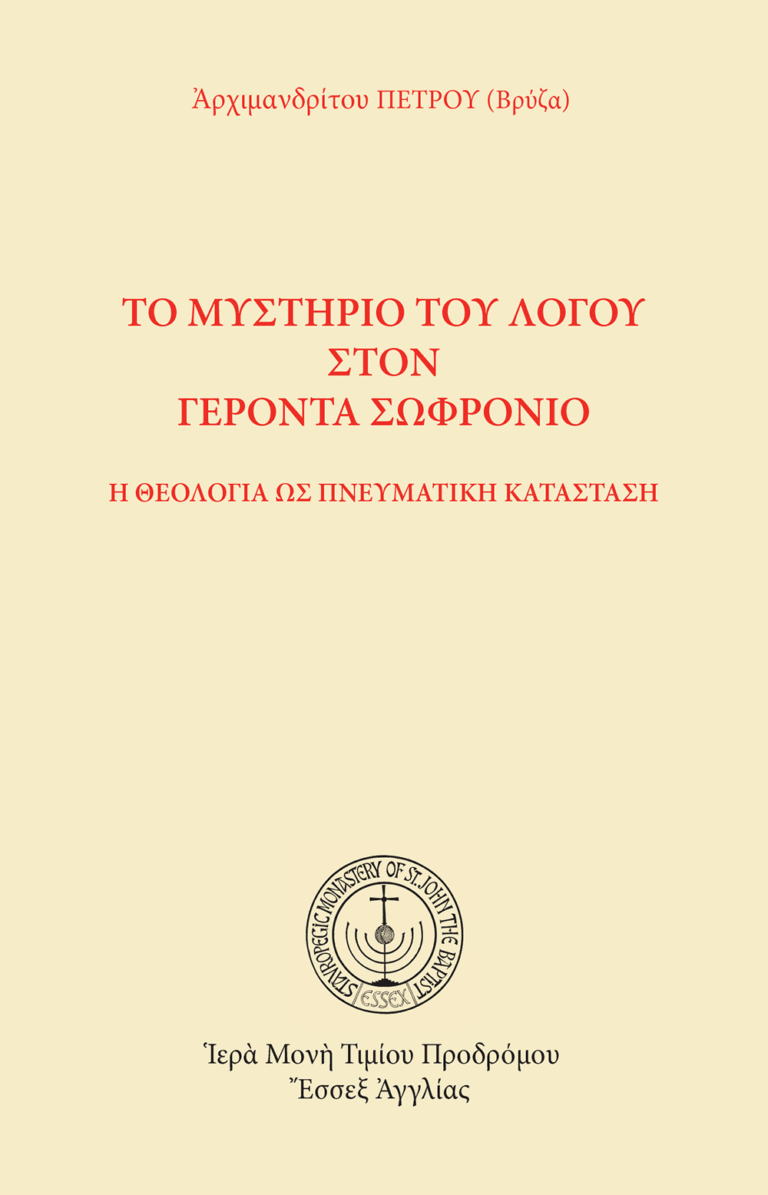
This book of Archimandrite Peter, the Abbot of our monastery, is an expanded version of his doctoral dissertation on the mystery of the word of God in the writings of Saint Sophrony. In truth, Saint Sophrony was above all a man in whom the word of God dwelt abundantly. Through the grace of the word conceived and borne in his heart, he performed his creative ministry as the Father and guide of many souls. Having seen the uncreated Light, he understood theology as the state of abiding in God. For him, theology was the narration of the event of his meeting with Christ during his rapture in the vision of divine Light. As he writes: “Authentic theology consists, not in the conjectures of man’s reason or the results of critical research but in a statement of the life into which man has been introduced by the action of the Holy Spirit.” Theology, then, is a gift of the Holy Spirit that quickens the heart of man. Whoever acquires this gift becomes a luminary in the world and possesses the word of life.’
Archimandrite Zacharias
Available also as eBook
€24.00
Theology as a Spiritual State
In the Life and Teaching of Saint Sophrony the Athonite
In stock
In stock
Secure payments
Ships worldwide
Free icon cards
Packed with care
Book details
Contents
PROLOGUE
INTRODUCTION
1. THE REVELATION OF THE WORD IN THE LIFE OF SAINT SOPHRONY
1.1. Biography
1.2. The Uncreated Light in the Life of Saint Sophrony
1.3. The ‘Boldness’ of Written Testimony
1.2. The Uncreated Light in the Life of Saint Sophrony
1.3. The ‘Boldness’ of Written Testimony
2. HESYCHASTIC PRAYER AND THE EMERGING OF THE DEEP HEART
2.1. Dogmatic and Ascetical Foundation
i. ‘In the image and likeness of God’
ii. The Incarnation of the Logos
ii. Participation in the Uncreated Divine Energies
ii. The Incarnation of the Logos
ii. Participation in the Uncreated Divine Energies
2.2. Prayer with the Name of Jesus and the Union of the Mind with the Heart
2.3. ‘A man shall approach and the heart is deep’
2.3. ‘A man shall approach and the heart is deep’
3. THE BIRTH OF THE WORD IN MAN’S HEART
3.1. ‘The Word of God makes man like unto God’
3.2. The Birth of the Word in the Heart
3.3. The Mystery of the Word in Saint Sophrony
3.2. The Birth of the Word in the Heart
3.3. The Mystery of the Word in Saint Sophrony
4. THE WORD AS THE FRUIT OF PURE PRAYER
4.1. Prayer as the Path to Knowledge
4.2. ‘The Word that came forth out of silence’
4.3. ‘The Word of God is cut short upon earth’
4.2. ‘The Word that came forth out of silence’
4.3. ‘The Word of God is cut short upon earth’
5. THE WORD AS A FRUIT OF THE CONTEMPLATION OF THE UNCREATED LIGHT
5.1. Conditions for the Contemplation of the Uncreated Light
5.2. The Properties of the Uncreated Light
5.2. The Properties of the Uncreated Light
i. Gradation in the vision of Light
ii. The twofold vision imparted by the Light
ii. The manifestation of the hypostatic principle in man through the ‘enhypostatic edifying gift’ of the Light
ii. The twofold vision imparted by the Light
ii. The manifestation of the hypostatic principle in man through the ‘enhypostatic edifying gift’ of the Light
5.3. The Uncreated Light and the Word of God
i. ‘The Light without beginning begets words in us’
ii. ‘The voice of God as the summit of contemplation’
ii. ‘The voice of God as the summit of contemplation’
6. THEOLOGY AS A SPIRITUAL STATE
6.1. ‘Theologising in an unerring manner’ in the Patristic Tradition
6.2. Theology as a Spiritual State in Saint Sophrony
6.3. From Apophatic to Cataphatic Theology
6.2. Theology as a Spiritual State in Saint Sophrony
6.3. From Apophatic to Cataphatic Theology
7. THEOLOGY AS KNOWLEDGE OF THE MYSTERY OF THE WAYS OF SALVATION
7.1. The Gift of Theology as the Fruit of the Sacrament of Obedience
7.2. The Three Stages of the Spiritual Life: from the Desert of Divine Chastening to the Land of True Theology
7.3. The Ultimate Criterion of Theology – Love for Enemies
7.2. The Three Stages of the Spiritual Life: from the Desert of Divine Chastening to the Land of True Theology
7.3. The Ultimate Criterion of Theology – Love for Enemies
EPILOGUE: ‘How do the perfect speak?’
Index of Biblical References
Bibliography
Available in 3 languages

More from the author

About the author

Archimandrite Peter Vryzas
Archimandrite Peter studied theology at the Aristotle University of Thessaloniki. He began his monastic life at the Monastery of St John the Baptist, Essex in 2001. Since 2019 he has served as the Father Hegumen of the community. Read more…



Customer reviews
Add a review


In stock


Andrew Kellighan (verified owner) –
A remarkable insight to the Orthodox approach to Theology
This is a remarkable book. Having come from a western theological formation I can say that with great difficulty one would find such tomes in the western canon of theological literature. It is the Abbot’s PhD thesis I believe and yet it reads like a prayer book of high spirituality and is to my eyes (trained with reading much drier academic dissertations) a remarkable testimony to the fact that in the East- Theology is not the preserve of the university, but rather is alive and well in the praying hearts of the monastic communities-who lead the way in the true school of Theology-the praying heart.
James Ambrose (verified owner) –
This is an incredible book, I would wholeheartedly recommend it, especially to those wanting to understand the Orthodox approach to theology as opposed to a speculative approach.
Brenda Redshaw (verified owner) –
This book has been instrumental in me leaving Protestantism for good. I had been hovering over the decision to leave for a few years, having considered my previous beliefs heretical, but the task of converting felt too extreme being in my 70’s and finding the cultural change too much to adjust to.
However, the reminder of Orthodox spirituality, laid out in this book, made me see that I could never adapt to what I no longer identified with. Very grateful for this.