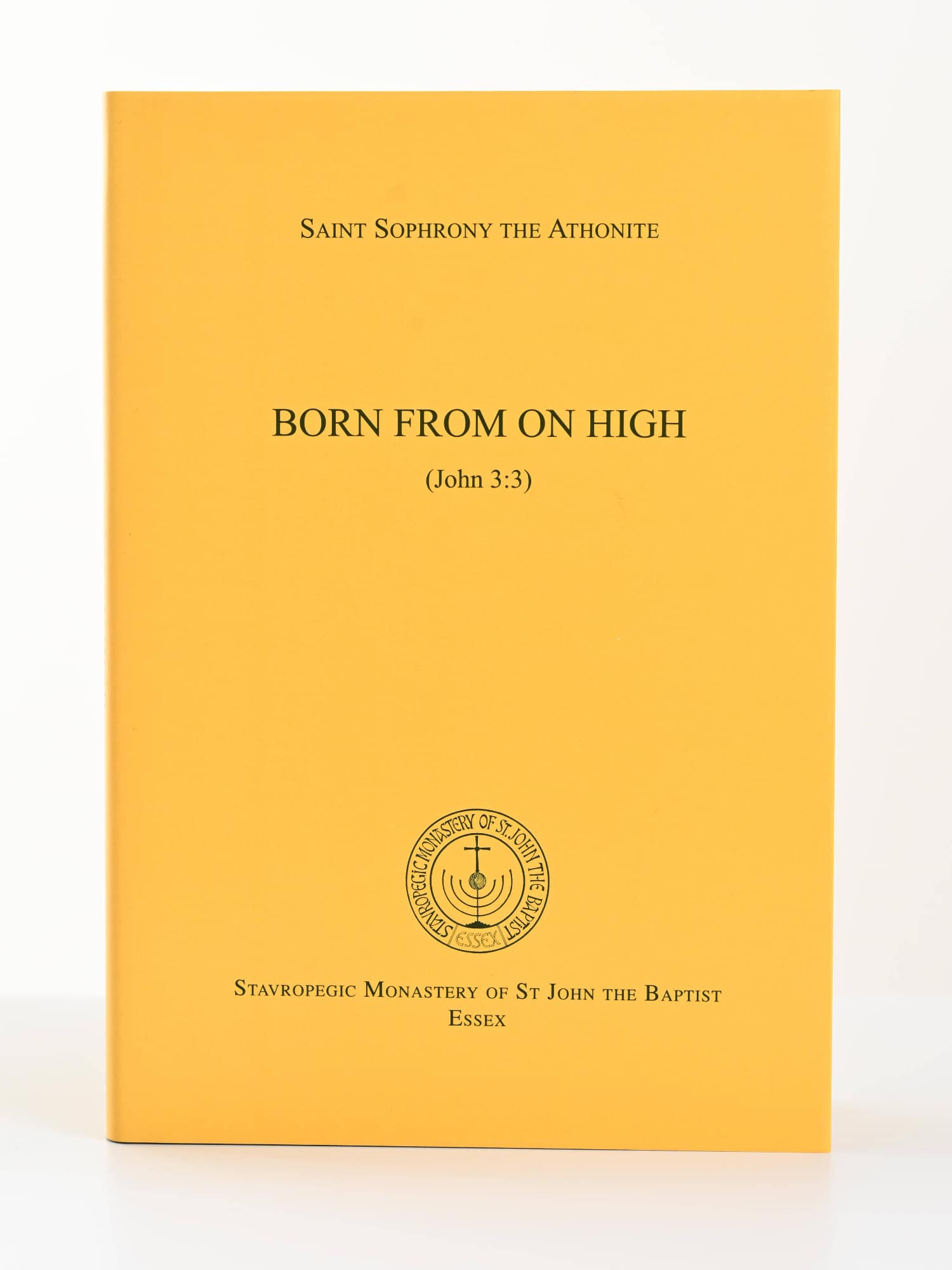
Born from on High

(John 3:3)

$21.00

The present book contains chapters St Sophrony wrote on the theological and ascetic basis for Christian life. He writes about the Christian life of married couples and of those called to monasticism.
Themes which are central to his thought, such as personhood, and repentance, are looked at again here, but as ever with fresh and ins­piring insight.

In stock

In stock

Secure Payments

Shipping Worldwide

Free Icon Cards with every Order

Packaged with Care

TABLE OF CONTENTS

Translator’s Preface

Introductory Reflections
Chapter 1: Theological and Ascetic Path
Chapter 2: Theology as Prayer and as the State of our Spirit
Chapter 3: Image and Likeness
    i On mankind
    ii Man as person 
    iii The Christian vision of man’s greatness
    iv A foretaste of the Kingdom
    v Mankind in our time 
Chapter 4: On Monasticism
Chapter 5: Marriage and Monasticism
Chapter 6: Two Kinds of Humility
Chapter 7: Obedience and Prayer
Chapter 8: Prayer and Redemption
Chapter 9: Repentance
Chapter 10: Notes on Ascetic Practice
    i Likeness to Christ 
    ii Forgiveness of sins 
    iii Monastic ‘health’ 
    iv Grace 
    v Salvation for all
Chapter 11: My Testament
Chapter 12: Contemplation

Index of Scriptural References

Book Sample

Excerpts (5)

The adherents of this evil doctrine see themselves as the highest humanists, strange as this may seem. In support of this there is the fact that they are opposed to another legalised wrong, democratic capitalism. Opening a ferocious war between these two ‘humanist’ political systems leads to an incredibly great amount of suffering for the majority of mankind. Capitalism builds its palaces upon the seas of blood, upon the mountains of corpses, bestowing some freedoms on certain strata of society. Communism suppresses every freedom: of conscience, of thought, of choice between ways of life, of participation in world culture, of the press, of communication with representatives of world civilisation, and many other such freedoms. Everything is suppressed by terror, everywhere the lowest spiritual elements predominate, trampling down all the normally accepted rights of man.

The history of the whole world is full of insoluble contradictions. With the denial of Christ will come inevitably an apocalyptic end: the world will burn in the fire created by people themselves. The divine-human Christian path is actually followed only by a tiny fraction of humanity. Perhaps, however, precisely these chosen few bearers of suffering love are the meaning of history. Each one who is saved by Christ is of immeasurable value.

— Excerpt from: Born From On High (p. 94)

Christian personalism has its most perfect expression in the prayerful movement of all-embracing love. In the practice of this Christ-like love the Christian gives himself unreservedly to the others whom he loves: first and foremost to God, and then by the power of the Holy Spirit to all other people. In this selfless love he transcends himself: love lives in the other, and not in self-love; those whom someone loves constitute his life. But living in the other, the person who loves does not cease to be himself. By going out of its egocentric limits, love eventually embraces all things, and will embrace and unite all things. Egotistic individualism inevitably brings isolation and separation because of the fight for temporal survival.

— Excerpt from: Born From On High (p. 52)

The disposition of soul in people who have come to know God’s visitation may seem incomprehensible, in that they really think and feel that they are worthy of hell and eternal torment. Yet at the same time it is not despair that possesses them — their whole being is filled with a feeling of greatness of the holiness of God, forever blessed.

The vision of the infinite holiness of the humble God-Christ brings the consciousness and feeling of the sin that lives and works in us, to such an extent that a person really feels ‘compressed’, and in a great impulsion of his whole being towards God, and a strong aversion to his evil, he plunges into weeping. The soul’s desire to become like God in holy humility then becomes like a fatal thirst. A particular spiritual sorrow from awareness of one’s abomination mightily torments the soul. In this wearisome languishing after holiness there is already a rudiment of holiness itself, and therefore the Fathers call it holy sorrow, and having come to love it for its holiness, they cherish it and safeguard it.

— Excerpt from: Born From On High • Chapter 9: Repentance (p. 94)

1. Neither intellectual theology without prayer of repentance, nor prayer, even fervent prayer, without mental theological vision, makes for perfection. The only knowledge which approaches fulness includes both the aspects described, united as one life.

2. The dwelling in us of the Father and the Son, and the Holy Spirit who is inseparable from Them, gives us the only trustworthy knowledge about God in actual living reality. We, as dwelling-places of Divinity, become, in a natural way, bearers of the fulness of divine Eternity.

3. The ascetic purification of our mind is necessary, so that we do not introduce elements of imagination (working upwards from the earth) into the dogmatic teaching of the Church about God, which is founded on the Revelation about the form of Divine Being.

4. Neither a philosophical nor a mathematical approach are applicable in resolving questions about knowledge of God. We begin with faith in the Truth of the revelation through Jesus Christ.
And the results of this faith confirm it and transform it into hope.

5. The dogmatic and ascetic teaching of the Orthodox Church is not some compilation of human conjectures or ‘cunningly devised fables’. What characterises her teaching is that it is not subject to any systematisation, and it presents to its hearers the experience of life.

6. The teaching of the Church is an expression in human words of what was really seen and known by the holy Apostles, the Fathers of the Church and the generations of ascetics who succeeded them.

7. We can only know God by the Holy Spirit, and the proud man who aspires to know the Creator with his intelligence is blind and foolish.

— Excerpt from: Born From On High • Chapter 1: Theological and Ascetical Paths (p. 20-29)

Christian ontology is based on the Revelation ‘I Am He Who Is’ (Ex. 3:14) — Being is I. Here I will reiterate that where there is not this personal principle, there is no being of any kind. To avoid this abyss of non-being, we must reject the philosophical method, which proceeds from our own self, and instead build all our life upon the rock of the Sinai revelation, which was fulfilled to perfection by Christ and by the descent of the Holy Spirit upon mankind. Christian prayer is the standing of the created person before the Personal Godhead; prayer face to Face.

— Excerpt from: Born From On High • Chapter 2: Theology as Prayer (p. 45)

Reviews (0)

Reviews

Customer reviews

No reviews found

No reviews match your current filters. Try adjusting or clearing your filters to see more reviews.

Be the first to review “Born from on High”

Your email address will not be published. Required fields are marked *

0 / 100

Drag & drop files here or browse

Images: up to 5 files, max 5MB each | Videos: up to 2 files, max 50MB each, 60 sec max

In stock

I found 595 items that matched your query "".